Other Tours
Below are some suggestions for day trips from Collioure
- Explore the Côte Vermeille
- Explore the charming village of Cadaqués in Spain
- Explore the Aspres region (Castelnou, Serrabone Priory, Orgues d'Ille-sur-Têt)
- Explore the Cathar castles


Côte Vermeille
We highly recommend this tour, which lets you explore the Côte Vermeille by combining a stroll, culture, and the beach.
Duration: between half a day and a full day (depending on whether you choose to walk up to the tower and your interest in the small Maillol Museum).
1- The Madeloc Tower
Leave Collioure by following the signs for “Notre-Dame de Consolation” / “Tour Madeloc.”
After a 25-minute drive, you’ll arrive at the base of the tower, at an elevation of 650 meters, where you can enjoy a magnificent 180° panoramic view of the Vermeille Coast. Please note that there are several hiking trails leading to the tower. Strictly speaking, this isn’t a hike—you’ll park at the base of the tower and then walk up a very steep paved road that’s closed to cars. After a 30-minute climb (so we recommend wearing sturdy sneakers), you’ll be rewarded with a breathtaking 360° panoramic view.
Of course, it’s best to go early in the morning or late in the afternoon for the best temperatures and colors.
2- The Maillol Museum
Head back down the paved road, get back in your car, and drive down toward Banyuls through the vineyards. After entering Banyuls and passing the roundabout where there’s a small supermarket, a sign on the right will point you to the “Maillol Museum,” named after the 20th-century French sculptor. It’s a charming little museum where you can take your kids without risking a tantrum.
3- Anse de Paulilles (Côte Vermeille)
Get back in your car, drive through Banyuls (which we’ll save for a future dedicated visit), and take the Côte Vermeille road toward Collioure. Between Banyuls and Port-Vendres, stop at Anse de Paulilles (which will also be the subject of a separate article) for a well-deserved swim followed by a meal on the beach at the restaurant Le Sole Mio.

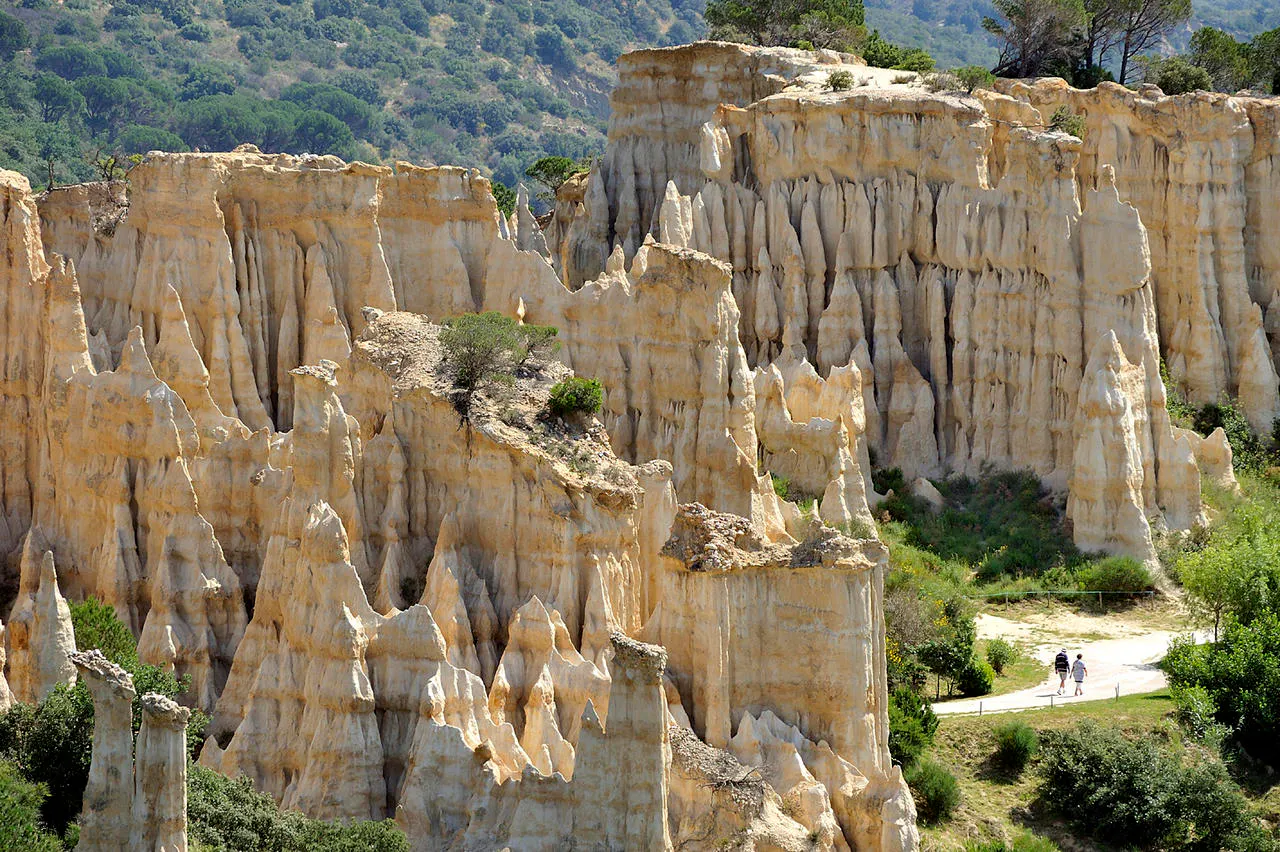

Castelnou – Serrabonne – Orgues d’Ille-sur-Têt
This one-day tour will allow you to discover Castelnou, a village listed among the “Most Beautiful Villages of France,” to recharge your batteries at the serene Serrabonne Priory, and—if it’s not too late—to hike through the heart of the stunning geological site of the Orgues in Ille-sur-Têt.
Stop 1: Castelnou
The stunning village of Castelnou is located 40 minutes from Collioure. Take the D914 toward Perpignan, then exit 8. Follow the signs for Thuir, then Castelnou.
This perfectly preserved village of 300 residents is nestled in lush greenery. Coming from Thuir, the view of this village with Mount Canigou in the background is magical. Once you pass through the village gate, you’ll find winding cobblestone streets, charming houses, balconies bursting with flowers, artisan shops, and many staircases leading up to the castle—which is open to visitors and overlooks this remarkably uniform village (there are no modern houses).
To learn more about the village of Castlnou, visit the Tourist Office website.
We invite you to continue your excursion by heading toward the beautiful Priory of Serrabone.
Step 2: The Priory of Serrabone
From Castelnou, allow 40 minutes (27 km) on a very scenic road. Leave the village via the D48, then take the D2 toward Caixas; after the turnoff for that village, follow the signs for Col de Fourtou on your right. After passing the church in Le Prunet, turn right onto the D618 toward Serrabone.
This secluded, hilltop priory, built in the 11th century, is a marvel of Romanesque art. The capitals of the south gallery and the church’s pink marble gallery were carved by the region’s finest sculptors. Before leaving, don’t forget to take a moment to breathe in the Mediterranean scents of the botanical garden.
You’ll find some practical information about the Priory of Serrabone on the Tourist Office website.
You can return to Collioure (1 hour – 65 km) at the end of this Stage 2 by taking the D618 down to Bouleternère, then taking the N116 expressway to Perpignan, which you’ll bypass to the south to reach the D914. On the D618, you can stop at the Relais de Serrabone to discover delicious local products offered by local producers.
Step 3: The Orgues d’Ille-sur-Têt
From Castelnou, allow 20 minutes (13 km). Head toward Ille-sur-Têt; the geological site is located near this town of 5,000 residents, just across the Têt River, which originates at the foot of Pic Carlit at an altitude of 2,400 m, flows through Perpignan, and empties into the sea at Canet-en-Roussillon.
This geological site is particularly striking. It bears a resemblance to Cappadocia in Turkey and certain landscapes of the American West.
Be sure to take a walk through this unique site soon, as it is gradually disappearing each year due to the severe erosion of its sandy and clayey rocks.

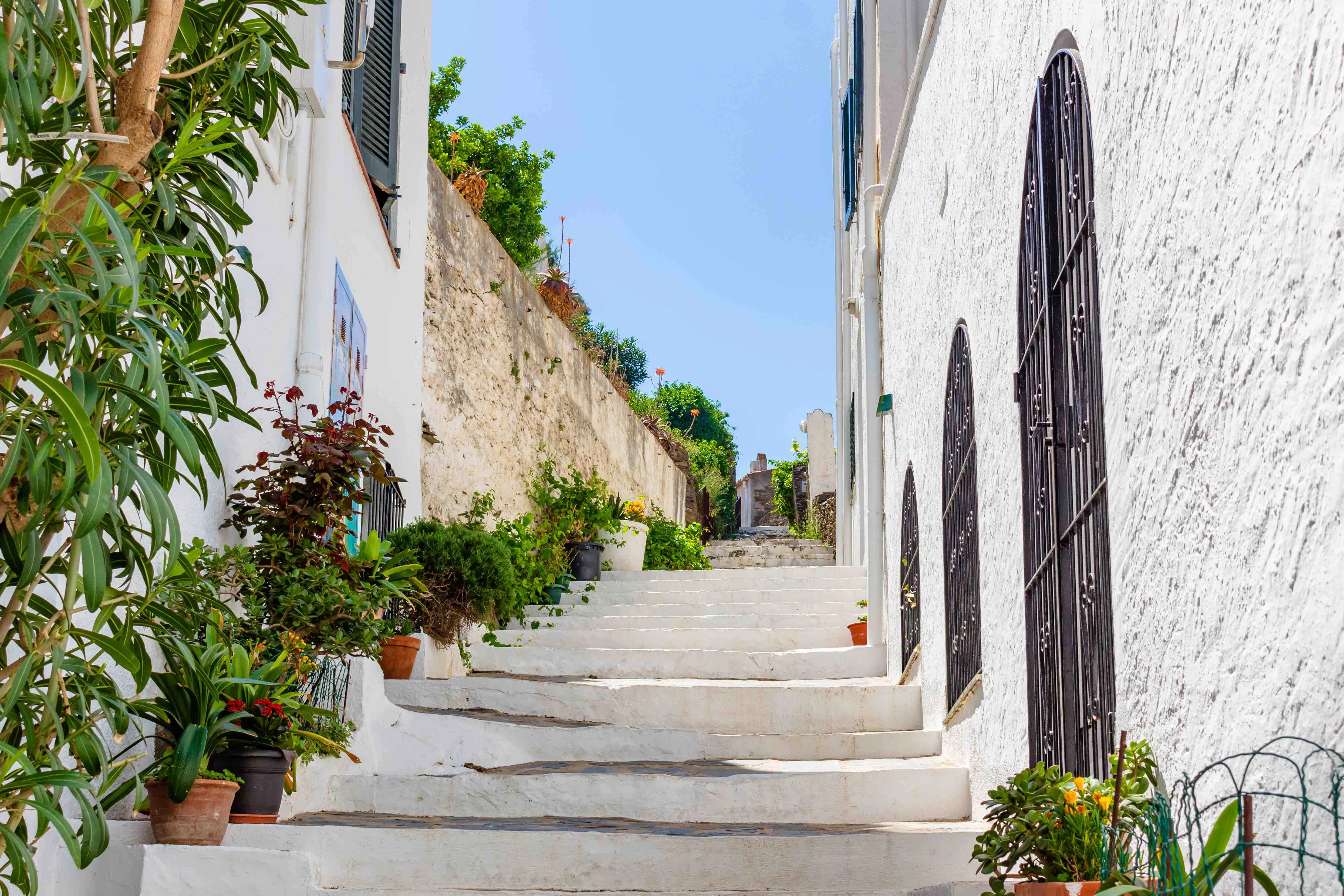


A Day Trip to Cadaqués
We’re offering a one-day excursion to Cadaqués.
Of all the villages along Spain’s Costa Brava, Cadaqués is undoubtedly the most charming, with its church and white houses facing the sea, its narrow streets, its fishing boats, and its unique light.
The village isn’t easy to reach, but it’s well worth the effort.
Option 1: Cadaqués by boat
Available only on certain days of the week and weather permitting
You’ll board the boat at the Marco Polo Pier in Port Argelès, located 2 km from the hotel (see the map below). You should have no trouble parking your car nearby. The boat departs at 9:10 a.m. and returns at 6:25 p.m.
You’ll spend about 4 hours in Cadaqués (from approximately 11:30 a.m. to 3:30 p.m.) and enjoy splendid views of the Côte Vermeille and Cap de Creus on both the outbound and return trips.
The return trip takes longer because the boat explores the coves of Cap de Creus.
You can book your tickets by phone at +33 614 19 65 84 or online.
Option 2: Cadaqués by car
On the way there, we suggest taking the coastal route to Cadaqués. The road is beautiful but winding and tiring. It will take you about 1 hour and 20 minutes to reach Cadaqués.
When you arrive in Cadaqués, we recommend parking in the main parking lot at the entrance. You can then stroll leisurely through the narrow streets.
You’ll find plenty of information on the Cadaqués Tourist Office website.
After your stroll, we suggest you explore Salvador Dalí’s remarkable house in Portlligat, located 2 km from Cadaqués. He lived there for 52 years, from 1930 to 1982, when his wife Gala passed away. He then decided to move to Púbol Castle. A veritable labyrinth—the house is actually a combination of several old fishermen’s houses—you’ll be immersed in a surrealist world.
Please note: it is not possible to visit this “house-museum” without first booking online.
We then invite you to head to the Cap de Creus lighthouse, where you’ll discover a series of beautiful coves stretching for 3 km. You won’t be able to resist taking a quick dip.
For the return trip, we recommend taking the road to Figueres (GI 614) and then heading back via the E15 highway to Le Boulou. From there, follow the D618 to Argelès-sur-Mer. The travel time is the same (1 hour 20 minutes), but the route is much straighter!
Additional Information
On the way there, along the coastal road, we invite you to visit the San Pere de Rodes Monastery. It takes 20 minutes to get there from Port de la Selva (10 minutes by car, then a 10-minute walk along a paved road).
This monastery is a marvel.


The Cathar Castles
If you’re staying in Collioure for a week, we invite you to spend a day exploring the Cathar Country. To reach this mountainous region in the Aude department, allow 1 hour and 15 minutes by car (66 km). It’s a bit far from the hotel, but the view of the castles of Quéribus and Peyrepertuse, perched atop impregnable rocky peaks, is unforgettable.
Please note: avoid this trip on days with strong winds, as these two Cathar castles are particularly exposed.
To get there, take the D914 toward Perpignan, bypassing it to the south, then take the D900 and the N116 toward Prades. Next, take the Corneilla La Rivière exit and continue on the D612 toward Estagel, then on to Maury via the D117. From there, follow the signs for Château de Quéribus (D9).
Quéribus Castle
From the parking lot, it’s a 10-minute walk along a fairly steep path to reach this “eagle’s nest,” which served as the Cathars’ last refuge. Enjoy magnificent views of the Roussillon plain, the Mediterranean Sea, the Albères Mountains, Mount Canigou, and Peyreperthuse Castle, visible in the distance.
Then head back toward Cucugnan, a village dominated by a charming restored mill and known for its priest’s sermon, which was adapted by Alphonse Daudet. For lunch, we recommend making a reservation, as the number of restaurants is limited.
Peyreperthuse Castle
Next, take the road toward Peyreperthuse Castle, whose long silhouette is particularly beautiful and majestic. A 15- to 20-minute walk along a fairly steep path will take you to this castle, which stretches 300 meters in length.
Galamus Gorges
After this visit, you have two options: return via the same route you took on the way there (the shortest option) or continue on to the Galamus Gorges (the longest option).
Please note: We do not recommend visiting these gorges in July and August or during long weekends. The road is particularly narrow, and cars cannot pass each other except in a few spots. This results in significant traffic jams during the summer.
If you’d like to take a short walk, just before the exit from the gorges, you can leave your car at the parking lot for the Ermitage St-Antoine de Galamus. In 15 minutes, you’ll reach this hermitage clinging to the rock face, where you can stretch your legs before heading back to the hotel via St-Paul de Fenouillèdes.
A few words about the Cathars: Originating in the East and founded in 1167 by Bishop Nicetas of Constantinople, Catharism derives its name from the Greek word *katharos* (“pure”). Stemming from Catholicism but denying the divinity of Christ and rejecting traditional rites (baptism and marriage), the Cathar church was led by four bishops in Albi (hence the name “Albigensians”), Toulouse, Carcassonne, and Agen. As the heresy gained widespread popularity, a crusade was launched and led by Louis VIII. The conflict ended in 1255 with the fall of the stronghold of Quéribus, which had been built prior to this period in history.
A Note on the Cathar Castles
The “Cathar Castles” actually have no connection to the history of the 12th-century Cathar heresy! In fact, it was the King of France who built this series of fortresses following his crusade against the Albigensians.
The commonly used term “Cathar Castles” is therefore entirely inappropriate. We should actually refer to them as “Castles in Cathar Country.” We invite you to read the Wikipedia article on the Cathar Castles.