Villages
Below is a selection of charming villages to visit from Collioure
- Less than 30 minutes away: Port-Vendres, Banyuls-sur-Mer, Laroque-des-Albères
- Less than 1 hour away: Castlnous, Céret, Arles-sur-Tech, Eus, Villefranche-de-Conflent, Prats-de-Mollo-laPreste, Mosset, Bélesta
- Less than 1 hour and 30 minutes away: Cadaqués, Évol, Besalú, Castellfollit de la Roca, Pals
For each of these locations, we’ve listed the distance in kilometers and travel time from Collioure below.
If you’d like to explore other Catalan villages in Spain (between 1 hour and 30 minutes and 1 hour and 45 minutes from Collioure), we recommend: Peratallada, Monells, Begur, Santa Pau, and Calella de Palafrugell (between 1 hour and 30 minutes and 1 hour and 45 minutes from Collioure)

Castelnou, the medieval village of the Aspres
Listed among the Most Beautiful Villages of France, Castelnou is one of the most beautiful medieval villages in the department. Nestled in the Aspres region, with Mount Canigou as a backdrop, it retains a remarkable silhouette: ramparts, fortified gates, stone houses, and a viscount’s castle.
The tour is short but very pleasant. As you stroll up the cobblestone streets, you’ll discover stone facades, artisans’ workshops, views of the hills, and the village’s well-preserved atmosphere.
Castelnou makes for an excellent day trip from Perpignan, Thuir, Céret, or Collioure. It’s also a wonderful stop to combine with an exploration of the Aspres region and the Roussillon vineyards.
Distance : 40 km - 45 mn

Eus, the hilltop village overlooking Canigou
Eus is one of the most spectacular villages in the Pyrénées-Orientales. Perched on the hillside, it overlooks the Conflent Valley and offers a remarkable view of Canigou. Its houses seem to cascade down in terraces from the Church of Saint-Vincent, which crowns the village.
The best way to explore the village is on foot, winding through steep, cobblestone alleys lined with stone facades, stairways, flower-filled squares, and panoramic views. Eus is often described as one of the sunniest villages in France, which contributes to its distinctly Mediterranean atmosphere despite its inland location.
It’s a must-see stop if you’re staying near Prades, Villefranche-de-Conflent, or in the Têt Valley.
Distance : 71 km - 55 mn

Villefranche-de-Conflent, the fortified town at the foot of the mountains
Villefranche-de-Conflent is a village like no other. Listed among the Most Beautiful Villages of France and marked by Vauban’s fortifications, it is also part of UNESCO’s World Heritage Site.
The village unfolds within its ramparts, among narrow alleys, shops, historic houses, and views of the mountains. Above the village, Fort Libéria overlooks the valley and rounds out the visit for those who wish to gain some elevation.
Villefranche is also the iconic starting point of the Train Jaune, which connects the Conflent Valley to Cerdagne. It is therefore an ideal stop to combine heritage, mountains, and a unique rail experience.
Distance : 80 km - 1h

Évol: The Charm of a Mountain Hamlet
Évol, part of the municipality of Olette, is one of the most beautiful mountain villages in the Pyrénées-Orientales. Listed among the Most Beautiful Villages of France, it stands out for its stone architecture, slate roofs, natural surroundings, and unspoiled atmosphere.
Here, the charm is more understated than on the coast. Visitors come for the tranquility, the traditional houses, the narrow streets, the church, the castle ruins, and the mountain scenery. Évol feels like a village frozen in time, ideal for those who love simple, authentic places.
A visit here can be combined with a trip to Villefranche-de-Conflent, Olette, the Carança Gorges, or an excursion to Cerdagne.
Distance : 95 km - 1h30

Prats-de-Mollo-la-Preste, a fortified town in Haut-Vallespir
Prats-de-Mollo-la-Preste is one of the major fortified villages in the Catalan region. Located in Haut-Vallespir, south of the Canigou massif, it combines ramparts, colorful narrow streets, Vauban-era fortifications, and a mountain backdrop.
The village has a strong Catalan identity. Visitors can explore Fort Lagarde, the Church of Sainte-Juste-et-Sainte-Ruffine, historic facades, fountains, and the lively atmosphere of a mountain town. Prats-de-Mollo is also known for the Fête de l’Ours, a major folk tradition in the Vallespir.
It’s a slightly longer excursion from the coast, but well worth the trip to discover a more mountainous and border-region aspect of the Pyrénées-Orientales.
Distance : 64 km - 1h

Mosset, a charming village in the Castellane Valley
Mosset is a village less well-known than Castelnou, Eus, or Villefranche-de-Conflent, but it’s well worth a stop. Located in the Castellane Valley, above Prades, it offers the lovely atmosphere of a mountain village, with ancient alleyways, stone houses, and unspoiled natural surroundings.
The village charms visitors with its authenticity and tranquility. People come here less for spectacular landmarks than for the overall atmosphere: the stone buildings, the narrow streets, the views of the surrounding hills, and the feeling of already being in the Pyrenees.
Mosset is best explored at a leisurely pace, as a complement to an itinerary around Prades, Molitg-les-Bains, Eus, or Villefranche-de-Conflent.
Distance : 82 km - 1h

Laroque-des-Albères, a balcony overlooking the Roussillon plain
At the foot of the Albères Mountains, Laroque-des-Albères is a charming village nestled between the sea and the mountains. Its narrow streets, historic houses, church, tower, and views of the Roussillon plain make it a wonderful stop in the hinterland of the Côte Vermeille.
Laroque is also a great starting point for hikes in the Albères Mountains. The village offers a variety of experiences: a bit of history, a bit of hiking, and a bit of nature—all while remaining close to Argelès-sur-Mer, Collioure, and Saint-Génis-des-Fontaines.
Distance : 18 km - 20 mn
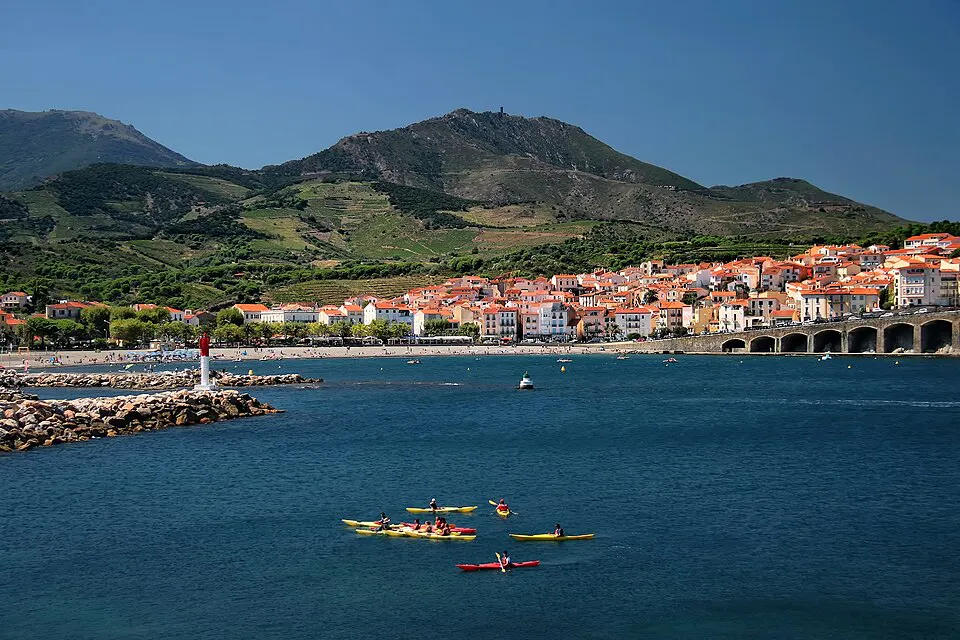
Banyuls-sur-Mer, a village of sea and vineyards
Banyuls-sur-Mer is one of the major villages of the Côte Vermeille. Less of a postcard-perfect destination than Collioure, it offers a more open atmosphere, with views of the sea, terraced vineyards, and the landscapes along the Spanish border.
The village is known for its wines, coves, harbor, waterfront, and coastal trails. It’s a wonderful stop to combine walking, swimming, wine tasting, and Mediterranean scenery.
Banyuls is also a gateway to the coastal trail, the Cerbère-Banyuls Marine Nature Reserve, and the scenic roads perched high above the sea.
Distance : 13 km - 20 mn

Port-Vendres: A Catalan Port with a Maritime Atmosphere
Port-Vendres is more of a port than a picture-perfect village, but it deserves its place among the most charming spots in the Pyrénées-Orientales. It has a very strong maritime identity: docks, boats, a fish market, seafood restaurants, port architecture, and views of the Côte Vermeille’s rugged landscape.
Port-Vendres’ charm is different from that of Collioure. It’s less picturesque, more lively, and more focused on the sea and port activities. People come here for the atmosphere, the walks to the lighthouse, the scenic viewpoints, and the nearby coves.
Distance : 3 km - 10 mn

Céret, a City of Art at the Foot of the Vallespir
Céret is more of a small city than a village, but its historic center, plane trees, market, museum of modern art, and Catalan atmosphere make it a must-see destination.
Céret’s charm lies in its balance of heritage, art, and a relaxed way of life. Stroll through the streets of the town center, discover the famous Devil’s Bridge, visit the museum of modern art, and then enjoy the cafés, galleries, and the atmosphere of the Vallespir.
It’s an excellent stop for those who want to leave the coast and explore the interior of the Pyrénées-Orientales.
Distance : 35 km - 35 mn

Arles-sur-Tech, Between the Abbey and the Tech Valley
Arles-sur-Tech is another beautiful stop in the Vallespir. The village is best known for its Sainte-Marie Abbey, one of the oldest in Catalonia, but it also offers the charm of an old market town, with its streets, squares, and valley setting.
It’s an interesting village for understanding the connection between religious heritage, local life, and the mountains. A visit here can be combined with trips to Amélie-les-Bains, Céret, or Prats-de-Mollo-la-Preste.
Distance : 45 km - 45 mn

Bélesta, a stone village between Fenouillèdes and Roussillon
Bélesta is a lesser-known village, situated in a transitional region between Roussillon, Fenouillèdes, and the foothills. Its castle-museum dedicated to prehistory, its stone-paved alleys, and its arid, sun-drenched landscapes make it an interesting stop for those who enjoy venturing off the beaten path.
The village is best explored at a leisurely pace. It can be included in a day trip focused on prehistory, along with Tautavel, or as part of a broader exploration of the villages in the hinterland.
Distance : 65 km - 1h

Cadaqués, the White Village of Cap de Creus
Cadaqués is one of the most iconic villages on the Costa Brava. Nestled in the heart of a rugged coastal landscape, it charms visitors with its white houses, cobblestone streets, small beaches, and the atmosphere of a traditional fishing village.
Its charm also stems from its connection to Salvador Dalí, who lived nearby in Portlligat. The best way to explore Cadaqués is on foot, taking the time to wander up the narrow streets, stroll along the bay, and soak up the unique light of Cap de Creus.
Distance : 58 km - 1h15

Besalú, one of Catalonia’s most beautiful medieval villages
Besalú is a must-see destination for lovers of medieval heritage. Its large fortified bridge, cobblestone streets, historic Jewish quarter, and Romanesque monuments make it one of Catalonia’s most spectacular villages.
The silhouette of the bridge over the river is one of the region’s most famous sights. The village is a delight to explore on foot, with its arches, small squares, and historic houses.
Distance : 85 km - 1h15
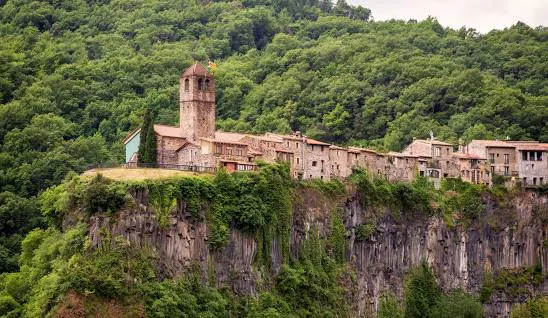
Castellfollit de la Roca, a spectacular village perched on a basalt cliff
Castellfollit de la Roca is one of Catalonia’s most impressive villages thanks to its location. The village sits atop a basalt cliff formed by ancient volcanic flows.
The silhouette is spectacular, especially when viewed from the vantage points outside the village. The village itself is small, but its natural setting makes it a memorable stop, best combined with a visit to Besalú or the Garrotxa region.
Distance : 98 km - 1h25